Eve Intersected with Kay, Shannon, and Alison
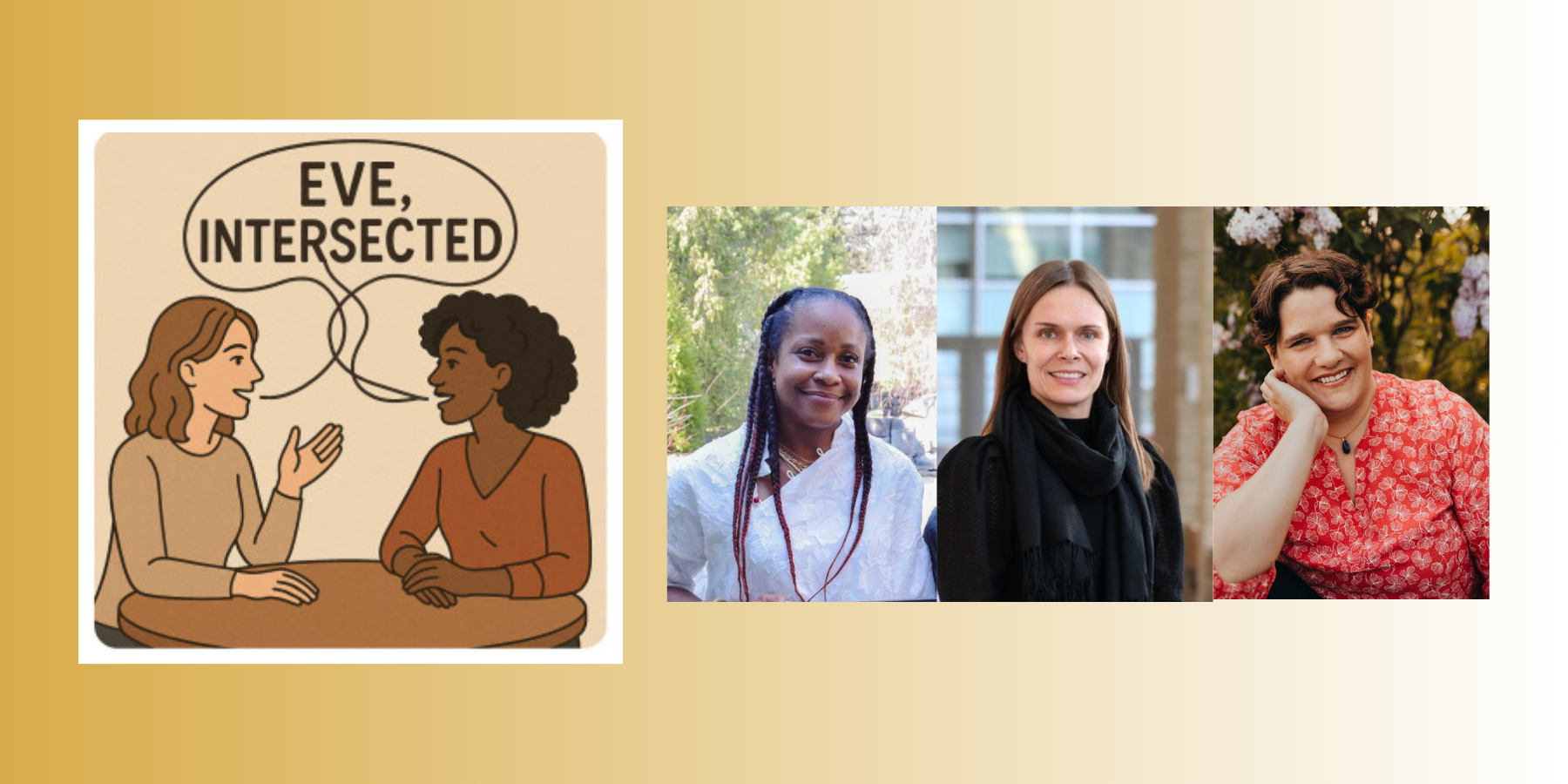
Amplified is an audio blog series about the sounds of scholarship from our team here at the Amplify Podcast Network. This month on Amplified, Stacey Copeland and Hannah McGregor are joined by Shannon Kerwin, Kay Waboso, and Alison Innes of Eve, Intersected. Together, we talk about why podcasting felt like the right avenue to bring their research beyond academic journals, including their lab work on anti-black racism in sports governance, and how the show models learning publicly across difference and institutional hierarchy.
-
[00:00:00] Stacey Copeland: Welcome to Amplified an audio blog and podcast about the sounds of scholarship from the Amplify Podcast Network.
I'm your host. Stacey Copeland and in this episode, we're sitting down with the team behind our sustained cohort podcast Eve, intersected, co-host Shannon Kerwin and Kay Waboso and producer Alison Innes from Brock University Canada. Their podcast grew out of something delightfully ordinary coffee and conversation.
From a lively discussion about the Kendrick Lamar Super Bowl halftime show, the team built what we unpack in this episode to be a kitchen table space for honest and sometimes uncomfortable conversations on identity politics through an ethics of care and relational knowledge making. Together we talk about why podcasting felt like the right avenue to bring their research beyond academic journals, including their lab work on anti-black racism in sports governance, and how the show models learning publicly across difference and institutional hierarchy. So pull up a chair at the kitchen table and let's get started.
[00:01:27] Hannah McGregor: Welcome to the Eve Intersected team. I'm wondering if you could start by introducing yourselves, but also tell us a little bit about. The podcast itself.
[00:01:38] Shannon Kerwin: I'm Shannon Kerwin. My pronouns are she, her. They, uh, my role is co-host, co-conspirator. I helped put this together with Kay and Alison, and then we have a wonderful additional member of our team, Andrew.
[00:01:53] Kay Waboso: Hey everybody. My name is Kay. My pronouns are, she, they, I am a PhD candidate out of the Department of Child and Youth Studies at Brock. I'm also an instructor for the Department of Sport Management as well at Brock University, and I am one quarter of the Eve, intersected family. Alison its you.
[00:02:19] Alison Innes: Hi, I'm Alison Innes.
I am behind the scenes on intersected, but I have the joy of. Producing and working with Andrew on the production of the podcast, which means I get to sit there and listen to Kay and Shannon talk, and uh, that's a pretty special thing. I'm a PhD student in interdisciplinary humanities here at Brock. And I'm working in podcasting.
[00:02:41] Hannah McGregor: Awesome. So who wants to tell us what the podcast is?
[00:02:44] Shannon Kerwin: The story behind the story. So Kay and I, I am a faculty member at Brock University, and Kay works in our lab as a research assistant. And so Kay and I had developed this bond early on, and I'm labelling it that way and Kay can label it however she would like.
We developed a bond early on in the lab where we would meet for coffee for different reasons. So yes, because we have worked together, but also just to catch up and we ended up talking about things that were happening in the lab work. But then also like, and then one moment in particular was around the Super Bowl.
So we're looking at American football. We talked about the game, the halftime show, and Kay illuminated something for me in that halftime show with Kendrick Lamar that I knew nothing about, and I felt like. So all of that to say in this coffee conversation, I was learning so much and we were bouncing ideas and then it was like, Kay, we should record this.
Like this is, I think, uh, this is something that folks might resonate with in terms of how I was interpreting what was happening, how we were communicating, and it felt like something that could resonate with someone. Essentially our podcast is us talking through issues that we know other people are thinking about and perhaps not talking about because they are sometimes uncomfortable conversations, but finding your person to really unpack something with and maybe where your people, and I think that was really how this came to life.
[00:04:11] Kay Waboso: So initially it was just two friends who have a safe space that we've created to have these conversations that in other contexts may be difficult to have, but so grateful for this safe space and this, again, ethics of care where it's so important for us to start with safety. But then what happened is we realised that, you know what?
What's happening here is that not only am I learning about you, but I'm understanding stories and experiences in your life. Either as similar to mine or unique from mine. Either way, there's power on either side because either we can resonate and say, okay, we have this in common. Or I can say, oh my goodness, this is an opportunity for me to create space to learn how someone else exists in the world.
There's so much power in that, particularly in the socio culturally and politically charged world, we're embedded within to hold space, to have conversations that bring us closer to understanding another person's lived experience.
[00:05:32] Stacey Copeland: It's really lovely to hear you talk about what brought you to the podcast and why Eve, intersected.
It sounds the way that it does because when Hannah and I and Kim and Robert were listening to this collection of podcasts for the new cohort, what really did stand out about your podcast was the rapport that you two have the connection that you can hear in the way that you freely speak with each other and work through ideas together.
And that is what I think really drew me into the podcast. So. What I'd love for you to speak a little more on is why specifically did you choose then to produce a podcast as a medium and a podcast in relation to your academic work?
[00:06:22] Kay Waboso: The thing about this space is through my scholarship and all the work and all the readings I've done, trans disciplinarily one of. The pieces of knowledge that stuck with me the most is, you know, podcasts, they offer the space for relational engagement. They centre the fact that knowledge is never created in isolation, right?
Rather, we curate our reality based on the entanglements we have with each other. And so this is the quintessentially
best space for us to bring this exciting knowledge that we wanna mobilise because we want to be in relationship with our audience. We recognise the fact that on our own, in isolation, nothing really mobilises, but together in this community that we hope to build. We hope to share relational agency. We hope to extend to our audience the fact that wherever you are, whatever you're doing, you can be empowered with the knowledge.
The knowledge is that we're mobilising and you can do something with that, whether it be passively or actively. That's enticing.
[00:07:48] Alison Innes: I think one of the real strengths that Kay and Shannon have as co-hosts is their relationship and the care that they demonstrate for each other, and that care is genuine. So I came into this project of feeling a bit of an outsider.
Um, I'm in humanities, I know nothing or very little about sports and, uh. I'm a PhD student. You know, we're all aware of the hierarchies and things in academia. I'm in a new role for me as like producing for other people. I'm used to kind of doing my own podcast, my own thing, where it's just me and now it's like other people's voices and stories and.
Instantly that care that they have for each other was extended to me. From the very beginning, it was made clear. I think Shannon even said something to the effect of, we each bring a different expertise to this project. And so they were looking to me with my experience with podcasting, they're very much extending their care to myself, to Andrew, to their guests that come into the studio.
So it's a very genuine care and because they care and create that safe place. They're demonstrating vulnerability and I think that's one of their strengths as well, is they're not afraid to say to each other on air. I don't understand. I thought this, and I think that invites the listener in. To be like, oh, it's okay that I don't know this.
Because sometimes with these issues, we can sometimes feel afraid to admit what we don't know, or we might be afraid to learn in case we make a mistake, and Kay and Shannon are willing to go there themselves. And so they're very much not just talking about these issues, but they're demonstrating how to be vulnerable and how to have these conversations.
Yeah,
[00:09:32] Hannah McGregor: I love that.
[00:09:32] Shannon Kerwin: And if I can just build one last layer on that is, historically, in my 13 years in this academic institution, I fit myself in these little boxes that were created by the institution. So we publish in academic journals, we go to academic conferences, and that's how we translate our research.
And so what. Happened in our lab. We were doing work on anti-black racism in sport organisations and how we work with organisations to handle issues related, um, to anti-black racism and their governance in particular, and. One of the things I kept thinking about over and over was if this sits in an academic journal, it absolutely means nothing that I can't continue to publish this work in just those spaces.
I understand that's the currency of the institution, but how do we actually make change? If we want this to mean something and that's, I'm gonna talk to my other people that are sitting in the same walls. And so we were really reflecting on that in the lab and then just conversations that Kay and I started to have, and I see Kay's passion and Kay has this wonderfully creative side that I always see where she's thinking about that, even though also embedded in the.
Institution. It's always like, how do we get this message in different ways to different people? And then that's where I get it sort of just happened that then we're connected to Alison and we think about podcasting. This is, I believe, our way to then speak to folks that this will, I think, be meaningful too.
Also, I identify as a settler white, middle-aged woman in the Canadian space, the land now known as Canada. And I think other people who may identify in a similar way to me may have similar questions. And so translating that in this way, I could never do that in an academic article in terms of, oh yes, I'm vulnerable, and guess what I've felt that way.
And maybe in that way I was being racist according to some of the conversations we had and how I'm seeing it. And I'm thinking, oh my goodness. What do I do about that? And the podcast in our conversations has actually selfishly helped me think of how I can be a better person and a better activist in my space.
So all of that to say, okay, traditional ways of having impact and academia, uh, not cutting it. And this podcast feels like that can be a different way to really communicate something that might be meaningful. And this idea of like why the podcast is a way to mobilise, it feels like that's the only way or one way to push past how we traditionally will communicate our research.
[00:12:10] Hannah McGregor: I am so struck by the connections between how the three of you're articulating your interest in podcasting. You know? Kay. Your emphasis on the relationality of how knowledge is created. This idea that like that is actually how we learn the world. It's how we understand the world is through relational knowledge, co-creation, and then the element of how inherently vulnerable it is to let your co-creation of knowledge.
Be something that is happening in public out loud, not to sort of tidy away all of those threads and edges and seams and then put it into a polished article form. But to actually let people, to invite people in, right, to invite people to sort of virtually sit at the kitchen table as we were talking about before we hit record, to like sit at it with you and participate or listen in on that conversation and to be willing to do that.
To be willing to learn or to not know, or to be uncomfortable out loud as a way of sort of modelling that as like, this is not an existential threat to you. You can correct one another or just be curious about one another out loud. And that doesn't mean that you're not, you know, an expert can be, can be very, very hard.
I think particularly for early career scholars, right? There's a, a safety that comes with institutionality, but to be like, I, you know. I am somebody who doesn't sit fully within that position of expertise, but I'm still gonna be vulnerable, I think is really powerful.
[00:13:41] Kay Waboso: There's something you said there that I really need to pick up on.
Yeah. You used the between strands, threads and seam. Mm-hmm. I would very much describe myself in that way. I've always been very comfortable being vulnerable, but I was vilified for it in the academic space. I'm also a little bit quirky. I can be a little dramatic at times, right. That's my concoction. Not it's normal, but it's never been something that was looked upon kindly in the academic institution.
Yeah, I was always vilified for the things that really are my core strength, the core strengths of my character, and it took me a long time to unpack that and really understand what's going on and be able to circle back around to embracing. When you said that Strands, seams and threads. I just thought, oh my gosh, she's describing me 1000%.
Yeah. Now put strands, seams, and threads in the university and see how they fare. So this is very much a space to centre those voices, those experiences, those opportunities, and for everybody equally and alike.
[00:14:48] Hannah McGregor: I love that. Yeah. I've been drawn drawing on sewing metaphors a lot lately. Which is which, considering that I don't sew is, I don't know. Stolen valour.
[00:14:58] Stacey Copeland: You dabble in embroidery,
[00:15:00] Hannah McGregor: I do embroider, I do embroider and the backside of my embroidery. A hot mess. Apparently it's a like point of pride for some people that the back of your embroidery looks as neat and tidy as the front and mine. It does not. It absolutely doesn't matter.
[00:15:14] Stacey Copeland: It it's okay to be messy. Yeah. It doesn't matter what the process is. Look what you produced.
[00:15:20] Hannah McGregor: No. Yeah. Except, you know, the process is the joy for me. So that's a hard thing also, right to like. Balance when we are making something, when we are making media to put out into the world to really balance that care for the process.
Mm-hmm. With that sense of like, you know, the quote unquote professionalism of the product that we're putting out, which, you know, comes up a lot in podcasting because there are all of these sort of emergent norms around. What professionalism sounds like in the podcasting space in that regard?
[00:15:56] Kay Waboso: I think I can say we doff our hats to Andrew and Alison because truthfully, I feel like, I don't even think about the product yet, but the trust that we have with this Family Eve podcast is, I know that.
Alison is eyeballing the process and the product so that I can only have to eyeball the process where, you know, I thrive and find joy. So again, I doff my hat to you guys. I've said it to you, but I'll say it again here. Yeah.
[00:16:27] Alison Innes: Thanks. And just to continue your embroidery metaphor, which I absolutely love, like I think Kay and Shannon are turning the embroidery over and they're showing the messy side of it.
I think that's important for so many reasons. One of them being our current climate where expertise in things is dismissed, where perhaps women's voices are being dismissed and to say like, Hey, this is how we figure out what we know this is, this is, this is how we. Do academics, but it's not just academics.
It's part of. Being human and the human experience, if that makes sense. Yes.
[00:17:05] Stacey Copeland: I love this. I love talking through the joy of process. Maybe I was forgetting that because I was grading all day today, and that is not a process I always enjoy, but I should find the joy in again.
[00:17:17] Hannah McGregor: It's the worst part of the job.
I truly keep making my assignments more and more fun, and I still, you've never seen anybody procrastinate harder than me on grading day. It's like I have a million other things I could be doing.
[00:17:30] Stacey Copeland: But I mean, okay. So on process, when you are recording each episode, we talked about this podcast being rooted in conversations between the two of you and, and creating space to work through ideas, frustrations, curiosities together.
Who do you imagine you're actually speaking to with this podcast, and what, if anything, do you know about your listenership so far?
[00:17:52] Alison Innes: Yeah, so the process is really interesting. It's been a learning experience for me. Definitely. When we sit down to have a conversation, there's kind of this idea that we're gonna have a conversation about X, like those first episodes about the Super Bowl halftime show.
I think we were talking about, oh, we'll just do one or two, and then it like exploded into four as we unpacked things, and I think. Certainly as the producer in the room while they're talking, I feel very much like I am in a Starbucks or whatever cafe of your choice, and I'm listening to the people at the next table have a really interesting conversation, and that's the vibe that I hope people get, that they can be as involved in that and listen as closely as they want.
[00:18:44] Shannon Kerwin: And just who I'm imagining is the person listening in. Particularly when I was thinking about that first episode series when we were talking about Kendrick Lamar, as Kay and I were sitting chatting on our own, I was thinking other people probably have no idea how significant. That halftime show was, and we always see this or I see this spectrum of folks that there's people that are never gonna care.
There's people that already are in the know and are on K side who are teaching like, look, listen, how wonderfully like symbolic all of this was. And then there's people in the middle that just have no idea. For whatever reason, I'm sitting in the middle, like my head's exploding, like, oh my goodness.
Thought that that was Serena Williams standing there. I had no idea. Like I was completely ignorant. I feel like I, in who I'm speaking to or who I hope, one of the groups that is listening is other people that want to be more aware and are looking for ways to expand their mind, and they just. Don't necessarily have access to that information yet, or I'm not hearing these stories, whatever it may be.
'cause we used to, we talk about this idea of woke being a really na like, nasty term right now. Like it's almost used as an insult. Whereas we're trying to flip that script like, we want you to be woke, we want you to hear more and learn more. And as Key had said, like I, I we're talking. Probably to women in some cases, but, or women identifying folks.
But we also want as many people to hear it as possible. If it's something that helps them see the world from a different lens, no matter what lens. And that's 'cause that's, so we're in a world where we're stopping that, where we're, we're hearing that people aren't doing that. They're being very narrow in their view.
And whether or not we agree with someone, just listen that and that's the audience that. I'm hoping it's people that are willing to do that.
[00:20:30] Kay Waboso: Yeah. And also from the intersection of race, we're hoping that, again, by embodying what we're trying to offer, that we will be able to draw on a larger audience because I don't think any one of us comes to this experience as an expert.
We may have pockets of knowledge that we lean into more or less, but we. Are legitimately all here co-driving the bus, learning from each other along the way. In a way that feels really important because it allows me and each one of us all to be available and to show up in the world authentically in service of someone else based on possibly some of the things we're learning about each other here.
Making us more available to be responsive to the human condition. Like for me, that's the highest ideal possible.
[00:21:26] Alison Innes: And to pick up on what Kay was saying there about the intersectional aspect of it, when I think of this as an academic podcast, it does not fit neatly into any category. It is inter and transdisciplinary in its very nature.
While Shannon's in sport management, it's not a sport management. Podcast. It's a podcast about human experience, and Kay and Shannon both do such an excellent job with all of the topics that we've addressed so far of just unpicking and unravelling. And I think the most recent kind of miniseries on indigenous athletes really showed that interconnection how we want to deal with issues.
Separately in silos, but they're never that way. They always come together in people. And so I think regardless of kind of what academic niche you put yourself in, I hope that for any listener there is a point of connection.
[00:22:19] Hannah McGregor: Yeah, I'm really thinking about this ongoing conversation we've been having about process and Kay's emphasis on learning and learning from each other through the process of making the podcast together.
And I'm wondering then feeding back into your. Teaching and research work. How is taking that work over here doing that sort of learning together, how is that coming back into, you know, your quote unquote day job.
[00:22:46] Shannon Kerwin: over the course of engaging with this podcast? In my course now, I have students listening to podcasts. Not this one in particular, but perhaps we might filter this one in, but podcast series to then connect podcast work to the theory that we're learning in the classroom. I just started that. This is the first semester I've ever done that. So just opening my eyes to podcasts as a communication tool.
Podcasting as a way of engaging information and recognising this is where our students are also, right? People aren't consuming knowledge the way I consume knowledge back in my undergrad degree. Aware of that and responsive to that. And so it's coming into the classroom, into my own teaching, and that won't be the only way, but that's where the start has come in.
[00:23:29] Kay Waboso: So. For me, it's just to take the authenticity that I bring to the podcast and apply that in my spaces of influence. Mm-hmm. Recognising, again, if it's all built off, the fact that there's power in relationship. Then going out there and building those relationships leading. With my authenticity, offering a little piece of me in spaces that I occupy, you know, sort of as an endorsement of who I am, of what I bring to the table, and as an example of inviting people into that authenticity.
Yeah, it is infectious when I teach, what I've realised as a direct result of. Some of the feelings, experiences, and feedback that I've had from podcasting, I've recognised that it's essential to break off a little piece of myself and offer it to them, right? Because they're really not buying into the course content.
They're buying into you, and in teaching you are. Mobilising a piece of yourself and your values and your priorities. And so to lean into that, it makes me a better instructor. It makes me a better teacher. It makes me more accessible, and it makes me like they see me as, and my humanity. My humanity is not detached from this experience I'm having.
And I think that has been inspired by the experiences we've been having in podcasting over the past year.
[00:24:53] Hannah McGregor: Yeah. No, I love that. I love that like the more. Un unprofessional. I mean, and I say that, you know, unprofessional, complimentary, we are, the more we feel empowered to bring that unprofessionalism into other professional spaces, and I think it's always a really powerful energy to bring into academic spaces.
[00:25:16] Alison Innes: Can I jump back to your question about research? Of course. So my PhD research is on ethics of care and relationships in podcasting. This collaboration with Kay and Shannon has been so timely for me. It's opened up a whole new way of doing research for me where I'm able to take the things I'm reading about and the things.
That I'm thinking through and bring those directly into the studio and then also take away from the studio questions and think, oh, like what, how could that have been different or just kind of, so there's a, a link between kind of the practise and the quote unquote academic work for me that I have not experienced before in past degrees.
And that to me is really exciting and really energising.
[00:26:01] Stacey Copeland: It's been so lovely to hear you all talking about the process of podcasting, starting the podcast, and as a, a fresh podcast out there in the world Now, um, I would love to hear what you are envisioning for the future of Eve, intersected.
[00:26:17] Shannon Kerwin: I just want to have folks come to our kitchen table as much as possible, and I think Alison and Kay, you both said it really well, like our audience is whoever.
Has some sort of connection to anything that we're talking about because we are really, truly bringing our research to life through. How can I see it? And I think there's little pieces that someone might resonate with and if then they continue on and speak about how we're talking about things and if it invokes a conversation in somebody else's kitchen, awesome.
I think that's where we want more people to dialogue. Getting more people to create really authentic relationships around different points of conversation. So I'm hopeful that we can just maybe spread the word more and hopefully we can share some of this conversation.
[00:27:05] Kay Waboso: It's so funny, as Shannon was offering her answer.
The like myriad of responses was going through my mind. I'm thinking I'll take, we'll take star on the Hollywood Walk of Fame. Thank you very much. I got my speech ready, lights, camera, action. They were, and I was like suppressing the laughter as I was laughing at my own jokes, which I do, and I think that's okay.
Yeah. For me, having said all that, the most important. Thing for me is process. I don't care about product at all in my life. So it's the process, the experience, it's the fact that man, if there's some small chance that we can just offer one person a different strategy, a different way of thinking, a different lens as a, a tool towards empowerment, seeing the world more clearly in the way it's meant to be, that is success, period.
Done.
[00:28:01] Hannah McGregor: Thank you for your, um, audible punctuation. I really love it.
[00:28:07] Alison Innes: I think, I think for me as the behind the scenes person, one of the things I'm most excited about is seeing Kay and Shannon inhabit and grow into their roles as podcast hosts. I mean, they're already phenomenal. They were phenomenal from the start, and I'm just excited to see them grow as podcast communicators.
And personally I'm excited to learn more from them because I do learn so much every episode. Uh, so please find us on YouTube and listen,
[00:28:35] Stacey Copeland: this has been too good of a conversation where I'm very sad that we are having to conclude, and it's been really lovely getting to know you all better, hearing also this through line of.
Process and the value of process and the value of building relationships as really what is important in what makes podcasting such a integral tool within the university system. So it's really filling my cup.
[00:29:00] Hannah McGregor: It's so true. This is the third one of these that we've done and I'm like, oh, this is really helping with the disillusionment and despair.
It's like really, really helpful to like have conversations with people who are doing work from. A place of the same. Values and understanding of like what we're all here trying to do. You know, a collection of feminists always a, a process of collective ungaslighting amongst other things. So thank you so much.
[00:29:29] Alison Innes: Thank you.
[00:29:30] Stacey Copeland: Thanks for listening to Amplified an audio block and podcast about the sounds of scholarship from the Amplify Podcast Network. You can find links to Eve, Intersected in our show notes. And learn more about our sustained cohort on our Amplify Podcast Network website. Catch you next time.
Transcribed with descript.com
-
Eve, Intersected is co-hosted by Kay and Shannon. Basically, we are two women identifying individuals with homes in academia, coming together to have conversations about navigating the world we live in today. Each month, we’re coming to you with real talk about life, careers inside and outside of academia, and balancing it all. Think of this as having a cup of coffee and conversations with your two girlfriends. Being knowledge seekers whose common bond is keeping it real, we invite all and everyone to join us on our journey of inquiry into the common spaces that exist with respect to intersectional women and non-binary individuals.
Nwakerendu (Kay) Waboso is a PhD candidate in Child & Youth Studies. I am a research assistant as well as an instructor in Sports Management. My research focuses on the principles of decolonization and anti-racism in education as well as sport.
Shannon Kerwin teaches and conducts research in the areas of organizational behaviour and human resource management in sports. Specifically, Dr. Kerwin has looked at how personal and organizational values align to enhance important organizational outcomes and safe sports culture, how HRM practices align to produce (or stall) equitable practice, and the role of conflict in the effectiveness of volunteer boards of directors. She has recently co-authored the 3rd edition (2025) of “Managing People in Sport Organizations”.
Alison Innes creates and hosts her own research podcast Project PhDcast and is a co-producer on Eve, Intersected. She was the host and producer of Foreword and the Podcast Learning Network for Brock University, where she worked with faculty and student researchers on knowledge mobilization projects. She is the co-creator of the independently-produced podcast MythTake. Alison holds an MA in Classics from Brock University.
-
Read more about Kitchen Table Feminism and Podcasting in Stacey, Hannah and co-author Katherine’s chapter for Podcast Studies: Practice into Theory (2025)
Intro + Outro Theme Music: Pxl Cray – Blue Dot Studios (2016)
Written and produced by: Stacey Copeland and Hannah McGregor
