Amplified is an audio blog series about the sounds of scholarship from our team here at the Amplify Podcast Network. This month on Amplified, Stacey Copeland and Hannah McGregor are joined by Averill Earls and Marissa Rhodes, two of the four co-creators of DIG: A History Podcast. In this conversation, we reflect on podcasting as a form of feminist public scholarship, tracing how DIG evolved from a graduate student experiment into a sustained, politically engaged history project.
-
Stacey Host VO: Welcome to Amplified, an audio blog and podcast about the sounds of scholarship from the Amplify Podcast Network. I'm your host, Stacey Copeland.
In this third conversation in our series featuring the newest additions to our sustained cohort of podcasters, we sit down with Averill Earls and Marissa Rhodes, two of the four voices behind DIG: A History Podcast. Along with Hannah McGregor, my co-director at Amplify, Averill and Marissa reflect on sustaining a feminist history podcast for nearly a decade—tracing how DIG evolved from a graduate student experiment into an explicitly feminist public history project.
Together, we talk about podcasting as a form of accessible scholarship, the integration of podcasting into academic teaching and research, the realities of funding and institutional recognition, and what it means to do feminist history that “matters” in a shifting political landscape. So let’s dig in with DIG: A History Podcast.
[00:01:25] Hannah: okay, we're gonna make you do that thing again where you say your names. So, could you please tell us your name and your pronouns? And I would love... Both of you to tell us what the podcast is, 'cause I bet you have a different elevator pitch on what the podcast is.
[00:01:43] Averill: I'm Averill Earls an associate professor of history at St. Olaf College in Minnesota and also the executive producer of Dig a History Podcast. My pronouns are she, her.
[00:01:53] Marissa: Hi, I am Marissa Rhodes. I am an assistant professor of history at St. Leo University. Just outside of Tampa Florida. And my pronouns are she, her.
[00:02:05] Averill: Podcast is a History podcast with an explicitly feminist perspective. And that's our elevator pitch that is on the website. That's our mission, right? That our goal is to bridge academic narrativization of history and make it accessible to the public. Because our idea is that we have access to the incredible libraries of our respective colleges and universities.
We have the opportunity to read those books, to synthesize those narratives and to make them into something that's consumable and approachable for a broad audience.
[00:02:40] Marissa: Man my pitch is like almost exactly the same i think sarah and elizabeth are the ones who would've been different April and i i think are pretty on the same page
[00:02:48] Hannah: Okay. Do you wanna channel a Sarah or Elizabeth pitch?
[00:02:53] Marissa: No, i'm scared elizabeth is gonna i don't wanna be on her shit list.
[00:02:57] Hannah: Grab a Ouija board and do your best. Wow, Elizabeth's shit list.
[00:03:00] Marissa: I think elizabeth would you know would also agree that it's um, definitely a feminist history podcast that we're bringing academic history to general audiences but i think that she would put a little bit more of a focus on the fact that you know we all have day jobs and this is this is our side gig and that A crucial aspect to us continuing this project and that makes it sustainable is that we... Use it to teach, you know, we will choose topics. If we know we're gonna teach a new class, that's a new prep. We're gonna choose a topic that's in there so that we're kind of get, get our brain space in there before we teach the class. We also create episodes that we can specifically use in class, you know we create for that purpose.
So I think she would emphasize a little bit more how we've kept this podcast going by integrating it into our normal day jobs.
[00:03:50] Hannah: Yeah. Do you. Monetize it in any way?
[00:03:53] Averill: We have a Patreon that produces about $250 a month, which is really generous of our listeners, our regular listeners and supporters. And then we also, through that, our previous...
ad based network. It was a network in name, but was really just a ad revenue generator. We earned between 50 and $150 a month through ad revenue as well,
that's all negotiated by a company called Ad Large.
[00:04:19] Hannah: Ad large and they, they drop them in.
[00:04:21] Averill: Yeah. Yeah.
[00:04:23] Stacey: So.
we got the pitch for you wonderful people at DIG to join the Amplify Podcast Network I was so impressed by exactly what you were just talking about, Marissa that how long you've sustained this podcast for and the breadth of material that's available through the series. I'm not a historian, but I do media history.
So I really enjoy history podcasts.
[00:04:47] Hannah: know how media historians do history.
[00:04:49] Stacey: I do history, but I am not a trained historian, so I love hearing historians talk about history. Listening to your show and seeing how long you've been doing this for, I'd love to hear you talk about what brought you to podcasting and why specifically podcasting to share and dig deeper into your academic work.
[00:05:08] Averill: The great tale of our origin. We were sitting in a classroom in the seminar room in the middle of the day on like a Tuesday. And we used to do these things when we were grad students called MAP sessions, Mutually Assured Productivity Sessions because graduate work is very lonely. So we would all gather to do our solo work together around a table.
And I happened to be listening at that point to... a podcast on YouTube, A recording of some lecture that somebody was doing just with some friends or for a class or something, and I was like, wow, podcasting is easy. We could do this. And then I said those words out loud. And then later I sent out a call on the graduate listserv to be like hey. Would anyone like to do a podcast? And then three or four random people. One of them was Elizabeth. We didn't know Elizabeth. Because I, Elizabeth is like beautiful. And always dressed so incredibly. That she was really intimidating to the frumpy among us
[00:06:07] Marissa: I knew her, i had class with her. It's a different cohort
[00:06:09] Averill: Well, I had never spoken to her and I was the one in charge at the time. Yes, I know, she's a different cohort, and she was very intimidating to me. So I'd never spoken to her, and then she responds that she wanted to be part of this, and there were a couple other people wanna be part of it.
And then Marissa and Sarah were like, hey, how come you didn't ask us? And I was like, well, why didn't you respond to the email? And then they were like, well, this is us responding now. And so then,
[00:06:32] Marissa: and also we get 500 listserv emails all the time, and I didnt read them all
[00:06:34] Averill: yeah, but they weren't for me, Marissa, and there you go. So. Then we were like, okay, let's launch a podcast. And it was terrible.
It was really terrible for the first year. We just sort of were throwing spaghetti at the wall to see what stuck. we, It was the History Buffs podcast. But We had no identity. We were like, oh, we're gonna make a graduate student life podcast and we're gonna tell people about what graduate student life is about. Then we quickly realized nobody cares about graduate student life. So the first episode we actually put out was a History of Veterans Day. which is part of Sarah's research, and she just put together this episode We recorded it, it was like 30 minutes and that. like, that was the one I was like, oh, this is what podcasting should be.
This is what's interesting to me. This is what I want to listen to. I want to hear these stories. I don't wanna hear an interview about graduate student life, 'cause that's fucking boring. That's our everyday reality.
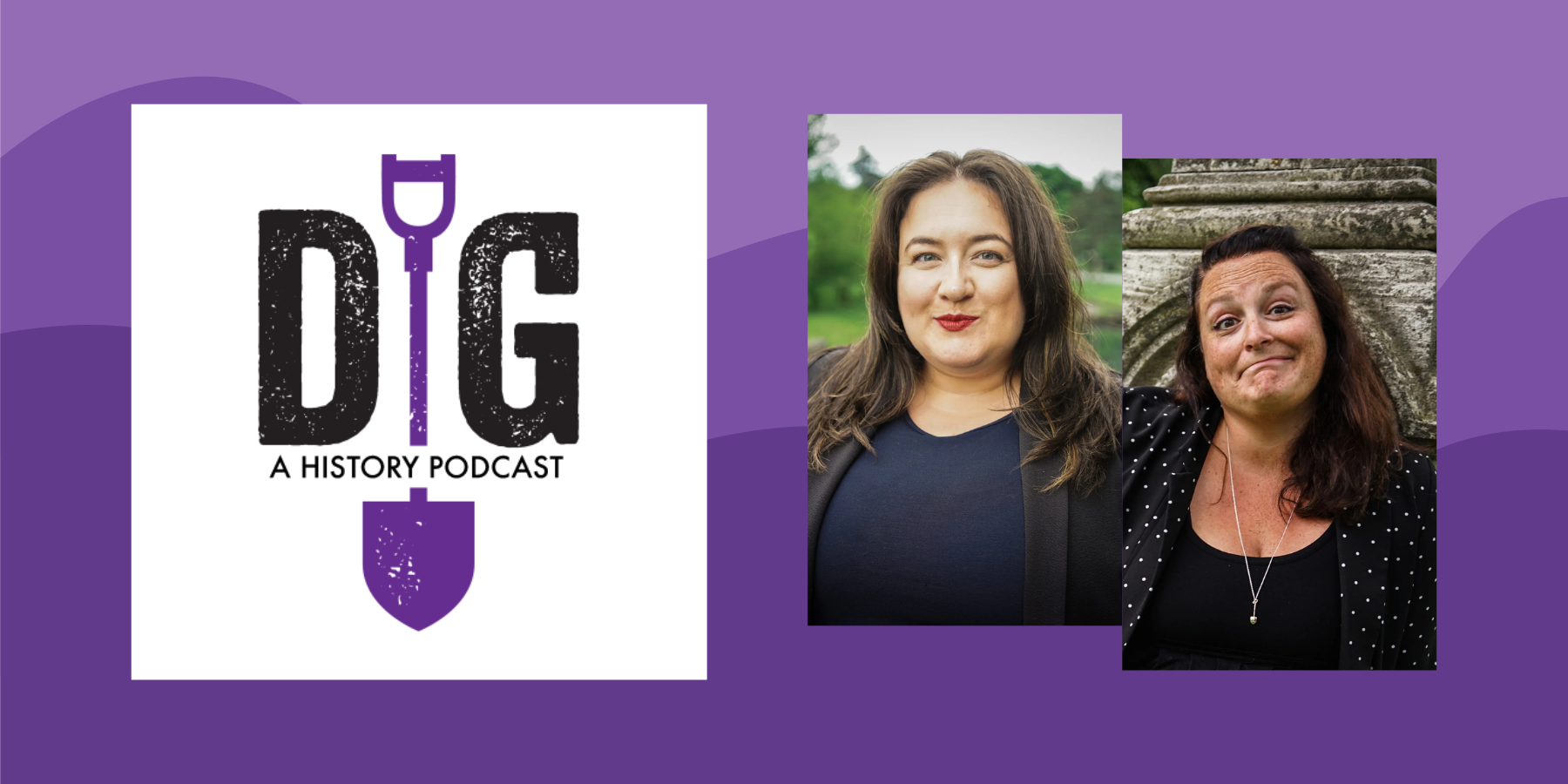
We did that for about a year and a half. Um, again, none of them were, were Like we were doing interview on the street type podcasts. Um, we were doing interviews with historians from our department. And then we were doing some of these narrative podcasts. And in the end we uh, let some talent go. Because not all were. Contributing equally Um, and we actually needed to completely overhaul our approach and what our vision for what the podcast was and what our identity was and that's where we decided this is gonna be an explicitly feminist podcast Um, all narrative driven where every podcaster, writes a full episode and then two people are, are on Um, and we're gonna do this In a set of four episodes or whatever um, and release over the course of a month. And that's what we launched in september 2017 DIG a history podcast with this great logo that was designed by my, uh, graphic friend Seth Neary in Vermont Just not, not because it means DIGing into history, it makes sense. Doesn't, doesn't scream feminist, but that was our identity. But damn if that shovel didn't look good in purple in between that D and that G
[00:08:37] Marissa: Now we have shovel, we have the tattoos.
[00:08:39] Hannah: Ah.
[00:08:41] Marissa: um, you the sort of external motivator that, came up in between our first podcast and then our rebrand and that was the 2016 election. And we all sort of became. You know, Activists, I guess, after that, in we really hadn't been before. and we felt like we wanted to do history that mattered, right?
Like we, started doing that with history buffs. Like We started some history is about the borderlands, Southwest United States and Mexico. And, Guadalupe Alvo and things like that.
and started doing that by accident just by, you know, hearing the news and thinking, oh, I could do a podcast about the history of that. and so then the 2016 election happened and, um, you know, it was part of the, the great disappointment of our lives and we, bring, um, balanced, well-researched, history to people, you know, storiesthat are often not told. the goal of doing history that matters and that makes a difference, in people's lives.
[00:09:41] Hannah: Yeah, so, with that sense of both sort of, We're doing public history, which I do think, you know, has has a tradition in history as a discipline that a lot of other disciplines don't have. Um, Do you have a sense of who your audience is, both who you're trying to reach, but also who your actual listenership is?
[00:10:06] Marissa: If Sarah were here, she would say, my mom. Because she thinks, Sarah thinks her mom is like our avatar. And I'm like, no, she listens to your podcast 'cause she's your mom.
[00:10:15] Averill: No, it's not her mom. It's her brother.
[00:10:17] Marissa: it used to be her mom, and then we made fun of her 'cause we're like, no, I don't think our listenership is quite that old, but it's people like Sarah's brother who, you know, are interested in, history, interested in learning and lifelong learning, are intellectually curious, have the. intellectual chops to kind of handle some of the more difficult stuff that we talk about that can get sometimes theoretical or really methodological or sort of difficult um people who have the patience for that kind of thing But who may, may not have access to a university library or may not have access to higher education um, in the same way that we, we have lucky to, to have to those things.
that was our avatar, I think when we launched, when we relaunched And that tends to hold up who actually listens to our podcast.
[00:11:03] Averill: but I think it's also still Sarah's brother too, right? Like he's a mechanic who didn't go to college and he, but he just loves to learn history. And hear these stories. Um, so I think it's him too. And we, this also holds up 'cause like, we'll walk into a mechanics shop or the dentist and hear our podcast being played right over their speaker.
So it's, it's out there in the world. And I don't know how it finds people, but it does. But then I think also, in addition to all those people that Marissa mentioned, it's a lot of students. Because a lot of academics have found our podcast because they're in our. our old social media networks back when Twitter was not a dumpster fire.
Um, a lot of faculty across the US and Canada assign our podcasts in their classrooms and, and so thousands of our listens are students doing the homework, which is always a gift as well.
[00:12:00] Hannah: Yeah. Yeah. that, like that spike that tells you that an episode has been assigned. You know, like, Oh, I see. Yeah.
[00:12:08] Averill:
[00:12:08] Stacey: I really appreciate hearing a little bit more about how the podcast is integrated into the way that you plan out your own teaching and also the teaching of other people and across institutions. tell me a little bit more about that? So thinking about the podcast, thinking about DIG, has it been that way from the very beginning that you've been able to integrate the podcast into your academic teaching and research, or is that something you've evolved along the way?
[00:12:33] Averill: Like our first series that we ever dropped uh, in 2017 was on the history of sex. And so... Sarah did an episode on the surprising history of Puritans and Sex, and Elizabeth did an episode on sex work in New York City.
and Marissa did an episode on the Marqui Assad, and I did an episode on.
Ooh. Now I don't even remember what that first episode was. but it was about sex. And that's my field of history. So that's what I do for my research. but I also teach history, several history of sexuality classes. And in my first and second level, courses, I assign all of those episodes I think I had always hoped to be able to do that kind of teaching, so maybe it was aspirational. 'cause fall 2017 was my first year on the tenure track after working at a job non-tenure track for a year. to be able to have control over a lot of my curriculum and the courses that I developed and the courses that I taught.
So I did use those that very fall in that class. I'm either writing an episode. That I just have had my curiosity peaked, And that will eventually find its way into one of my syllabi. Like the history of la petite mort, right?
The, Little Death or the orgasm in French literature.
it's something that's connected to my own research, right? I've done several episodes on policing sex or, Ireland, queerness like Roger Caseman or the Dublin Castle scandal. And those are all explicitly connected to my academic research for sure.
but a a lot of my episodes are also just one-offs that end up being things that just I was like, oh, that would be a great podcast episode.
[00:14:07] Marissa: my, answer for that is really different. I am not good at double dipping at anything or
doing anything practically, and I'm Absolutely kind of a ravenous learner and just always wanna learn things. Like I always wanna take on new preps I always wanna take on new classes I haven't taught before. And so when I, that's what I write about is just the things that I'm interested in.
and I never really consider. Whether it's gonna be useful for class or any Of that stuff. for me it's just about wanting to learn something new and being passionate about that.
But that being said, I do, assign our episodes in some of our classes, but my student, profile is really different from the students that like Ave is teaching. And, I find that, uh. Almost none of them will listen to a podcast they will read the transcript. they will do that. But they will not listen to a podcast. sadly, I have found with my students, even though we can get some of this content to them through the transcripts they don't get to enjoy how delightful I am And I tell 'em that all the time.
I'm really missing out guys. and we have little asides and things that aren't necessarily in our transcripts and things, you are not true transcripts Some of them are more sort of copy that we've written, um, for the episode. And some of them we've had like interns and who've been able to turn them into true transcripts So yeah, I just always tell them like, you guys are really missing out, you know? so I do use them in my teaching, but I have not found them to be as useful as the other three have.
[00:15:35] Hannah: I love that, that's chaotic. I've been podcasting for 10 years and I assigned a podcast episode of my own, for the first time this semester. I've never just like I wasn't teaching in the same areas that I was podcasting in.
but part of it was also a little bit of like, I'm pretty silly on there.
And I'm pretty silly in class, so I don't really know what the barrier was. But
[00:15:56] Stacey: do you want the double silly, right.
[00:15:58] Hannah: Yeah, maybe it's too much silly.
[00:16:00] Averill: Yeah. You wanna be serious in some
place. Someplace in their lives
[00:16:03] Hannah: Yeah. They'll know I'm never serious anywhere
and just a
[00:16:07] Averill: Sarah's students make fun of her for assigning her episodes in the classroom. They tell her it's really cringe.
[00:16:13] Hannah: Yeah.
[00:16:16] Averill: mine are much kinder to me.
[00:16:18] Hannah: I guess it really depends on the institution, huh?
[00:16:20] Averill: Yeah, It does.
[00:16:21] Hannah: Yeah, Yeah, It really does.
And on the student body,
I am really curious to hear more about how you have integrated your podcast into your careers. Like at the level of, to what degree has it counted as part of the work that you are doing? how do your peers you know, within your institution and within your discipline Receive your podcast, you know, do people think of it as research and I'm particularly curious in the context of history, because there is that tradition of public history, like does that maybe shift how people in your disciplines see this work?
[00:17:01] Averill: Yeah, it definitely depends on the institution. I was fortunate that my colleagues, I mean, we published a book together that was peer reviewed. I also just published my own book that was peer reviewed they're both by academic presses.
So. I. In the end, it doesn't really matter toward like a tenure case But I see it and I think this also works really well for Sarah because she's in a teaching specialist position part of my like teaching development ongoing and forever, right?
Because I'm doing work that is making me a better teacher always. And so I think my colleagues have, they consider the podcast part of my academic profile, in the way that one would write a, a textbook, right? That's synthesizing secondary literature into something that is a tertiary source and therefore useful and accessible in, in that way. And I think that's. that I've seen other institutions um, and other colleagues who are academic podcasters sort of leverage that as well. And we also you know, like have podcast to be peer reviewed by Digital humanities and other journals.
[00:18:04] Hannah: Reviews and digital humanities. Yeah. Yes, I read that review. I had noted earlier on when you were describing the work that, that it really sounds like you're framing it like in terms of OERs, for example, open educational Resources, and like that has its own framework for thinking about academic labor.
[00:18:20] Marissa: Mm-hmm. in my institution, the dean of the College of Arts and Sciences was on my committee, my hiring committee, and shortly after I was hired, she actually. took part in tenure and promotion rules and things that was happening that year. And made sure to have podcasts added as legitimate scholarships. So for me, they all count as scholarship. I would say that just 'cause my personality is what it is, I really struggle with self-promotion and with professional development kind of stuff. I kind of wanna, like I'm just a worker bee, I just wanna, teach my classes and keep my head down and don't
know. Like I almost never go to conferences or almost never, do book talks or almost ever do anything if I didn't have the podcast making me do those things. Um, because they don't come naturally to me, and it's not something I seek out. I don't seek out those opportunities.
But because of the podcast they seek me out and they find me.
you know, colleagues come by and say, oh my god, you were on the Paula Poundstone podcast. How, how did you not tell everyone in the entire world? And I was just sort of like, I don't know. And you know, they're like, that's a big deal.
You have to tell the president of the university. You have to tell everybody, you know. okay. And so for me it like makes me do the things that I would otherwise avoid pathologically.
[00:19:36] Hannah: I love that.
[00:19:38] Stacey: It is always so interesting hearing how the way that people's podcasting work counts varies so dramatically across institutions, how it's received by people. I mean, I'm really looking forward to sharing all of these different conversations we've had with members of the cohort, to just all hear the variety of experiences you've had.
Your. one of the podcasts that's been around the longest in our new cohort. but I would love to hear you talk a little bit more about what you're hoping to achieve in the future. So what do you hope in the next season or episodes or in terms of audience or impact? what is kind of the vision?
What's bringing you forward into the next few years of DIG?
[00:20:22] Averill: I mean, I think a renewed interest in just growing our listenership 'cause it has waned in the last couple years, especially after Apple Podcasts changed their algorithm for Subscriptions, right like if you're, podcast isn't released, episodes after so many weeks they unsubscribe you to it which is very sad because we like to take nice long holiday breaks. we are now you know trying new things to get back on the radar and be um, a regular part of people's lives including changing our entire release schedule now we're releasing every two weeks as opposed to A month on a month off, and then taking a long break in december and January. So, I mean that's like the practical side of the goals for the podcast in the coming year.
Um, is how we frame, seasons. Although we do series every, or five or six series a year. all those series are combined into a year long season. I dunno. haphazardly. 'cause again, this is like our.
unproductive un money generating uh, side hustle. I would love for it to be something that we could just do full time.
And I would quit my job for sure. but that's the future. Just kidding. I love my job.
[00:21:34] Hannah: Not me.
I fantasize about quitting every day.
[00:21:36] Averill: Every single day. on the sort of philosophical I'm interested in helping Marissa to change her ways and be more strategic in, uh, double dipping, because also her research and her teaching topics are super interesting and I think people would like to learn more about those things. excited to be a part of. Amplify and the, the like mission behind both the network and also interested those other members of the cohort, right? Like, Because we are aligned in I think a lot of ways both in terms of politics and driving force behind the work that we're doing. So I'm excited for the opportunities that we are creating together and, what that might mean for, all of our different shows.
every couple years we try to do something that will reinvigorate us as podcasters because you know, it's a long project to sustain this, time and energy. And so this is our new thing. I'm gonna try something and see how it works and hopefully it'll be as good as I envision.
[00:22:38] Hannah: Amazing. I mean, that's why we called it the sustain stream 'cause the sustaining part is, the hardest part.
[00:22:45] Averill: yeah,
[00:22:46] Stacey: And Marissa, how are you envisioning the future?
[00:22:48] Marissa: I have the sort of intrinsic, internal motivation to wanna move forward 'cause I just wanna learn new more things.
But I, I do think that probably it would be wise to make the podcast a little more, integrated into my life so that I have a better work life balance, I guess, um, would probably be what I aim for and what my co-hosts are always telling me to do.
So I need to be reigned in a little bit but yeah, I'm really looking forward to it. And I, and being in, I'm in rural Florida, In one of the fastest growing counties in the country it's an incredibly huge culture shock to have moved here from where I came from you know, it's really difficult for me to, adjust to the norms here Um, and there are, like, for example, there are certain podcasts that we have made that like I could not assign to my students and expect to keep my job
[00:23:45] Stacey: Yeah.
[00:23:45] Marissa: it's interesting
to sort of be constantly walking that line here in rural Florida. I look forward to you know, that one day not being a case. And for me to not be constantly conflicted about, you know, moving forward. So hopefully that is in our future one day.
[00:24:06] Hannah: Um, sounds like a really intense,
[00:24:09] Marissa: hate to be a bummer,
[00:24:10] Hannah: no, but the added complexity, right? You know, I made a podcast for four years called Secret Feminist Agenda, where in every. Second episode, I just talked about a thing that I was thinking about.
and I mostly thinking about politics, and, that space of like, I have academic freedom Mm-hmm.
That gets you, so far.
[00:24:29] Marissa: Yeah. And you know, we have friends who have been, I mean, not friend friends, but like, I guess they were Twitter friends and things who've been fired from their jobs. and that's probably another reason why our listenership has gone down a little bit because we've,
pulled from social media promotion, to a certain extent.
I tried to do a TikTok for a while last year, we got lots of views and things, but it wasn't really pushing people through to the podcast, so I stopped.
And also, like, it was just constant comments about, like how I'm gross, fat, and ugly, and stupid. And so I was just like, okay, I don't know if I can really do this anymore.
[00:25:03] Hannah: Maybe
[00:25:03] Marissa: yeah.
[00:25:04] Hannah: Maybe not how I wanna spend my time.
[00:25:05] Marissa: Exactly. So, that is an added complication, you know, I can't be loud on social media. I can't, I'll just be reported and fired, Um, yeah. we're navigating with that, and I, I hope in the future that we're still doing this podcast at a point when that doesn't matter.
And I really can say that I have academic freedom, you know, that would be great
[00:25:24] Hannah: Yep. Yeah.
[00:25:25] Stacey: Yes.
[00:25:26] Hannah: Yeah.
[00:25:27] Stacey: I mean, this is a topic we definitely have to explore in another conversation moving forward. It's been amazing talking to both of you
[00:25:34] Averill: thanks for having us.
Stacey Host VO: Thanks for listening to Amplified, an audio blog and podcast from the Amplify Podcast Network. This conversation with Averill and Marissa is the third in our Sustain cohort interview series. You can find links to Dig: A History podcast and more about the Sustain stream in the show notes, and tune in next month for the next installment in this series. Catch you then.
-
Dig: A History Podcast is a narrative-driven, open access, and accessible digital history project bridging the worlds of popular and academic history with an explicitly feminist perspective. Produced by Averill Earls, Sarah Handley-Cousins, Marissa C. Rhodes, and Elizabeth Garner Masarik.
Averill is a historian of modern Ireland and sexuality, and writes about same-sex desiring men, policing, and Dublin’s queer urban spaces. She is an Associate Professor of History at St. Olaf College in Northfield, MN, where she teaches European, digital, and sexuality history. She’s currently a host for the New Books in Irish Studies podcast and the Layout Editor at Nursing Clio. Love in the Lav: A Social Biography of Same-Sex Desire in Ireland (2025) is now available from Temple University Press. When she’s not teaching, podcasting, or moonlighting as a member of the Cabot Creamery Co-operative social media team, she enjoys board games, baking, and family time with her partner Dan and their dog Curie.
Marissa is an Assistant Professor of History at St. Leo University in Florida. She received her doctorate in History from the University at Buffalo in 2019. Her current book project tells the stories of lactating women for hire in the Atlantic world during the Revolutionary era. In addition to a BA in History from Niagara University, Marissa has an MLS from UB. She is a former fellow at APS, The Library Company/HSP & the Lapidus-Omohundro Institute of Early American History and Culture. She also served as the first Managing Director of the Journal of the Plague Year. But most importantly, she’s super into red wine, British television, and murder (as much as someone can be into murder without actually doing them – she even helped solve a cold case!).
-
Intro + Outro Theme Music: Pxl Cray – Blue Dot Studios (2016)
Written and produced by: Stacey Copeland and Hannah McGregor
