Love+Machines with Jul Parke
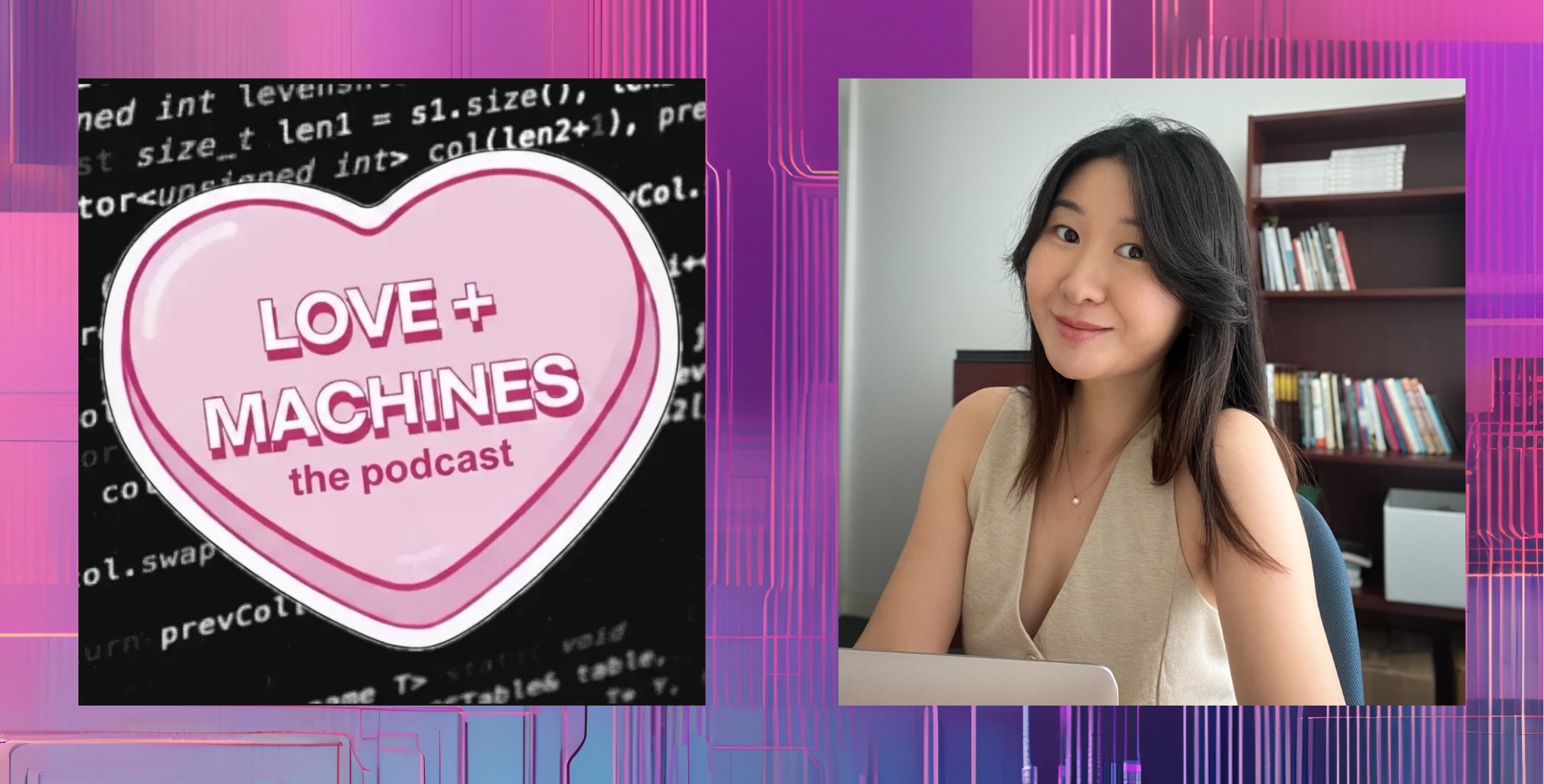
Amplified is an audio blog series about the sounds of scholarship from our team here at the Amplify Podcast Network. This month on Amplified, Stacey Copeland and Hannah McGregor are continuing our series of conversations with the latest additions to our Sustain cohort of podcasters by talking to Jul Parke. Jul is the creator and host of Love+Machines, a podcast about creative labour and critical futures. In this conversation, we reflect on
-
Hannah McGregor 0:00
Hannah, welcome to Amplified, an audio blog and podcast about the sounds of scholarship from the amplify Podcast Network. I'm your host, Hannah McGregor, and in this episode, we're continuing our series of conversations with the new cohort of sustain podcasters. Our guest today is Jul Parke, host of Love+Machines, a podcast that gossips about technology. Jul is a PhD candidate at the University of Toronto, where their research focuses on AI and culture. In this conversation, they sit down with me and my co director at amplify Stacy Copeland to talk about the importance of taking fun conversations seriously and why podcast interviews are a smart research strategy for early career Scholars. So let's get started with Love+Machines.
Jul Parke 0:57
My name is Julia. I also publish as Jul Jeonghyun Park. My pronouns are she/they, and my podcast is called Love+Machines, Love and Machines, and we are a podcast that gossips about technology, love, identity and loneliness, the rom com of tech news
Stacey Copeland 1:25
So good.
Hannah McGregor 1:26
I love that. I love gossiping about technology because, like, right away, it's such a striking juxtaposition of method and topic. You know that, like, what we consider to be the kind of thing that you gossip about. Technology, I think has this sort of, like, Wait, you don't gossip about technology. So, like, right from the beginning, there's this really sort of fruitful intersection of ideas that makes me feel very excited to go listen to those episodes.
Stacey Copeland 1:57
Like, are we? Are we hurting their feelings if they heard what we were saying about them?
Jul Parke 2:02
You know what I think from the conversations I've had, I do feel that some people would be hurt by the conversations we have on the podcast.
Hannah McGregor 2:09
Good. That's how you know you're having a good conversation.
Jul Parke 2:12
Or having an impact through conversations, which is what podcasts are about. But theoretically, gossip has a very important connotation in our field, algorithmic gossip is a concept coined by Sophie Bishop. It is a concept that refers to how creators on social media platforms create folk tales around how algorithms are affecting their work, and it's a necessary way of looking at the impact of algorithms in platforms on creators livelihoods, because it's such an in transparent system.
Hannah McGregor 2:47
I talk to my students about this phenomenon all the time, the like, the way that people sort of generate theories about how algorithms are operating and then spread this, you know, the whole like a selfie for the algo course. But I didn't know that it was sort was referred to as algorithmic gossip, whose term is that?
Jul Parke 3:05
Sophie Bishop.
Hannah McGregor 3:06
Sophie Bishop. Okay, so very excited about the content of this podcast. Let's talk about the form for a moment. So what brought you to podcasting specifically as a medium? Why is this the medium you chose to do this project in.
Jul Parke 3:23
Now this is so exciting to start a podcast, because I've been listening to podcasts obsessively since I think even before covid. I think after I graduated from my master's program, I started commuting more than an hour to my first job out of grad school and being the millennial that I am doing nothing for an extended period of time gave me so much anxiety. I think that's capitalist condition. And I thought, what can I do when I'm constantly standing being jostled by other bodies not able to produce for an hour and a half or more in the answer was podcasts. I was like, Oh, I'm going to learn so much stuff. I'm going to be an expert on US politics. I'm going to be so productive on my commutes. And the answer was podcasts.
Hannah McGregor 4:12
Did you end up listening to podcasts that made you feel productive?
Jul Parke 4:15
I did. I did. I'm slightly ashamed to say, but I am a big nerd for news podcasts. So I listened to The Daily from the New York Times religiously until Trump's second term, after which I stopped and The Ezra Klein Show, The Gray Area, Hard Fork, all the all the masculinist news cycles coming out of the East Coast of the USA.
Hannah McGregor 4:39
Yeah, sometimes you just got to listen to a white man talk about politics. It's just...
Stacey Copeland 4:43
It's a very it's a very popular genre, let's be real. So you started podcasting because you love podcasts, which is a great answer. I love that. But what made you want to join our network? So thinking about making a podcast, yes, but then joining. Amplify, and if you could speak a little bit to how you see love and machines fitting within our network's values. So open scholarship, critical pedagogy, anti racism, feminist, social justice, how does that align or resonate with how you're thinking about Love+Machines?
Jul Parke 5:18
I'm so excited about that question. So the biggest gripe that I found seeking podcasts that are my need to be productive, to be a productive, capitalist subject, is the realization that every time I approached a podcast made by an academic or about academic topics, they were so boring, they were, in fact, unlistenable. And so I think Amplify Podcast Network is possibly the only podcasting collective of academics that I have encountered that takes fun conversations seriously, I think Amplify, takes the mode the medium of podcasting really seriously, and that includes humor. It includes wit, it includes good music, it includes good timing and rapport. And I love the honing of the skill set that's reflected in this collective representation of podcasting greats. So I think I was just thrilled to join the inaugural cohort of Amplify Podcast School last spring, and once I came, I think I was additionally thrilled to meet such a pro human feminist, very neurodiversity accommodating queer network, because I don't think I've ever been in an academic space that's been so inclusive in a non stereotypical sense of that word.
Hannah McGregor 6:50
It's so lovely because it's all we care about. So it is nice to hear that it that it comes across and and always just like so valuable to meet other people who are also passionate about creating these spaces.
Stacey Copeland 7:06
Yeah, and I really appreciated the reflection a bit on the school as well. I've been thinking a lot about that now that some time has passed, and how special those spaces can be, and how how lucky we are to get to spend time in community that we can create around a sense of politics within the academic system. And I also wanted to flag Hannah, you should totally use fun conversation seriously as a podcast tagline. That's so good. But on that, you know, when we're making these podcasts, when we're thinking about who's listening to the network. How do you imagine who you're speaking to when you're creating Love+Machines, and what if anything do you know about who's listening so far?
Jul Parke 7:51
It's funny because I was asking, I was interviewing Paris Marx, the host of Tech Won't Save Us for an episode on this podcast. And I asked Paris, do you have a sense of your audience base? What are they like? And Paris said, No, I don't really know. I don't hear back normally once I put an episode out into the wild, and I think that's that hasn't happened to me yet, because such a small cluster of people listen to this podcast so far, that I get a sense of who's listening, which is friends of the guests, and the friends of the guests are also fellow academics or creative workers in the social media space who are progressive and pro feminist and pro needs of the human body. When I was conceptualizing the podcast, this wasn't quite the case. I've been a communications advisor for Statistics Canada for three years now, and how I came on to the agency was to be a social media consultant. I was hired on to help older researchers learn how to use LinkedIn to talk about their research at Statistics Canada. And it was a wonderfully rewarding time for me to help people who are not digital natives learn how to use a social media tool to talk about what they were passionate about that was rooted in empirical evidence and ethical guidelines. So when I think of how the podcast can go further, I see it being a tool to educate people who are not familiar with tech from either a demographic or geographic or gender perspective. I want it to be a conversation that helps people feel like tech is a domain for them to confidently speak about.
Hannah McGregor 9:39
So, so far in the process of making this podcast, have you found that the process of making the podcast has fed back into your research or your teaching, like is it impacting the way you do your other scholarly work?
Jul Parke 9:54
1,000% I am so thrilled about Love+Machines, because it's a fantastic excuse for me to reach out to a very famous person in my field and say, May I talk to you for like an hour? Yeah, not only will they normally say yes, they'll be flattered. So that's already great for me as a late stage PhD student trying to network in the wild.
Hannah McGregor 10:15
I love that.
Jul Parke 10:16
One crazy thing is that two of my interviewees for the dissertation agreed to be on the podcast. So the podcast episodes double as dissertation interviews.
Hannah McGregor 10:25
Hell yeah. Love that too. I tell the story of when I started Secret Feminist Agenda, it was literally just I'd moved Vancouver, and I didn't know anybody, and I wanted to make friends, and it felt less awkward to reach out to interesting feminists and be like, Hey, do you want to be on my podcast that felt less awkward than me? Want to be my friend?
Jul Parke 10:45
See, I love this. I have a section on this in methodology where I say, attention is a double edged sword. If I reach out to someone saying, Hi, I'm an academic, may I get you to sign some consent papers so that I can speak to you privately use it in my research project? they'll say no, but if I say hi, I think you are so cool, and so many people are going to listen to you talk about your opinions. Can you please come on my podcast? That's a legible form of public conversation will feel is much more rewarding than private one.
Stacey Copeland 11:18
That's the next podcast interview email I want: Hi, you're so cool. Can you come in talk to me on my podcast?
Jul Parke 11:25
I promise more people than me will listen to you talk.
Stacey Copeland 11:28
More people should send an interview request in that way.
Hannah McGregor 11:31
You're so cool. That's very close to the way that I invite people onto Material Girls. Like, I just reach out and I'm like, Hey, huge fan. Love you. Okay, so, so, so far, do you have a sense of how your podcast or the practice of podcasting is being received by your institution and or your peers you mentioned sort of it doubling up as your dissertation research. So are you? Are you finding so far that it is being sort of counted in a clear way as part of the research work that you're doing?
Jul Parke 12:06
I think that I'm deeply blessed in terms of the timing of my PhD. I won't say that for a lot of other things, but in terms of my podcast and research mobilization effort, it's been working well for me. I think the fact that I have Jas Rault, who's a co author on Heavy Processing, lesbian methodology, amazing professor and mentor to have regarding alternative modes of research, queer positive modes of research. M.E. Luka, who, herself, is doing a podcast and has been on Amplified to talk about her work. Rafael Grohmann, who is my fabulous Brazilian supervisor, who teaches podcasting to students, they've been so supportive of me and so instrumental in making me feel like this is a good contribution I'm doing as a baby academic in training and in a practical sense, I was just in Brazil a week and a half ago for the Association of Internet Researchers conference. This is the most important conference in our field, where maybe around 800 academics come together for a week long celebration of research in internets. And I was on a panel doing a presentation where things went terribly wrong. I felt like the moderator didn't appreciate my contribution, and I was thinking the whole time, oh, my god, he thinks this presentation is a joke, like I feel terrible being on here. But no, afterwards, he came up to me and he said, Hey, I'm so excited about your podcast, I can see this being a really important part of your job search, and I can see your expertise on podcasts really aiding you as a future Professor of Media and Communication. So that was news to me, the fact that my experience in making a podcast can actually give me a leg up in the job search, which has been increasingly more difficult with the shifting tides of geopolitics and academic funding.
Hannah McGregor 14:09
Good, good. I'm glad it's also, let's also just get some like, sort of marketable skills on our CVs. I mean, that's part of why, part of why I started podcasting was looking at the academic job landscape and being like, well, maybe a transferable skill or two.
Jul Parke 14:26
Well, I actually think your record of work, Hannah and Stacey, through peer reviewed podcasting with Wilfrid Laurier, and the whole existence of Amplify as an institution in the Canadian academic space has actually set so much groundwork for us, for this cohort of academics.
Hannah McGregor 14:45
I'm really glad that was the goal.
Stacey Copeland 14:46
Yeah. And, I mean, I think it's really interesting to take a look at the work that you're doing Jul, and the way that the University of Toronto has an infrastructure set for you, that there is a place for your podcast to live within the institution, to be affiliated with research groups and centers, that is a major shift that we've seen over the past decade, I would say, in how emerging scholars can really be celebrated for doing this kind of alternative and more public facing work. And I'm really excited to see how it intersects more with your dissertation work over the next year as well. And I guess with that, like future thinking hat on, I'd love to hear you talk more about what you hope to achieve with the podcast. What are your future thinking, maybe goals or ambitions for the podcast over the next year? You know how you've released the first initial episodes. What are you hoping is next for the show and series over the next year and into the future?
Jul Parke 15:46
My biggest hope is for us to be renewed for a second season. I'm hoping that season one is so good that the research cluster will agree when I beg them to give me funding for a second season, because the guests are endless. That's really what I'm feeling. One person that I talk to introduces me to another person that I really want to talk to. And the topics continue to come unfortunately, because the technology continues to evolve. One week I'm talking about therapy on ChatGPT, the other week, Sora comes out, and we have to talk about that. And I do think that there is such a specific niche that I'm targeting through these conversations, when we focus on emotions, when we talk about human affect, when we talk about things from a relational and quotidian perspective, I'm really excited about the chance to talk to people about topics that don't often come out in the Financial Times or even like the front page of Reddit or on Futurology. And on a more philosophical level, is, I mean, technology isn't inherently bad. It's so important to remind ourselves of that. I think the podcast is a good avenue for us to discuss the joys and the fears around technology, whether that's having relief to talk about your breakup and not hire out your friends, or whether that is getting permission to not feel embarrassed about using Pornhub. That was the whole basis of episode one, when I talked to Maggie MacDonald, a PhD candidate, who is also a board member of Pornhub. Lots of interesting takes that give people permission to feel things.
Stacey Copeland 17:27
The first two episodes already have me so pulled in.
Hannah McGregor 17:31
I'm so stoked.
Stacey Copeland 17:31
Another follow up question for the looking ahead, since it'll be a little bit till this comes out, and then we'll have even more to listen to. How did you go about choosing who to speak to for this season, and what can we expect?
Jul Parke 17:45
Now that's a big mistake on my part. That's that's a bit of a record of failure on my part. I was extremely control freaky around the topics. I had a proposal, I had episodes topics, and I thought, Okay, I'm going to talk about this, and I'm going to invite this person, because they are the person that I know with the closest claim to expertise on this topic. And I did that, and we didn't talk about the topic, so I had to go back and change all the episode titles. And so at some point, I decided the most important thing is, are they going to be fun to talk to or not, and am I prepared enough to know about their record of work and their passion so that I can interview them adequately in a way that is then interesting to the target audience of this podcast? And so far, it's been working out so well. I'm so happy, but it definitely wasn't the way I planned originally, in terms of how these conversations and the guest dynamics worked out.
Hannah McGregor 18:46
It's a constant tension, because when you have conversations with people, they're inherently unpredictable, and that's so fun and makes planning hard.
Jul Parke 18:56
Yeah, and it's a lesson in moving away from this being my project, actually. So even the conversation with Maggie, I went to Maggie being like, hey, Maggie, you're a porn scholar. I've been seeing all this AI porn on the grok subreddit. Let's talk about that. And Maggie was like, actually, I'd like to talk about age verification laws regarding porn access in the US. And then I was like, Okay, so that's what we talked about.
Hannah McGregor 19:23
Yeah!
Stacey Copeland 19:24
But I love that. That really speaks to the way that academic podcasting is not only about answering questions, but creating an environment and being someone who can facilitate the space for emerging conversations, rather than what has already been published or what is already being talked about in other spaces. How are we thinking about what's next in relation to the topics we're interested in? So I think... you've got the groundwork for our Season Two for sure here, I think,
Hannah McGregor 19:51
undeniably, Oh, amazing. Well, thank you so much for talking to us about Love+Machines. We're obviously already huge stans. So I'm sure everybody else who listens to this right now is feeling the same way, and is gonna go download all of the episodes you've released so far, which, this is gonna come out in the future, so who knows how many there will be.
Jul Parke 20:12
I'm thrilled.
Hannah McGregor 20:18
Thanks for listening to Amplified, an audio blog and podcast from the Amplify Podcast Network. This conversation with Jul Parke is the second in our Sustain cohort interview series. You can find links to Love+Machines and more about the Sustain stream in the show notes, and tune in next month for the next installment in this series. Catch you then.
Transcribed by https://otter.ai
-
Julia’s doctoral research examines the emergence of virtual influencers—AI- and CGI-generated humanlike characters—on contemporary social media platforms. Drawing from Platform Studies and Cultural Studies, she introduces the theoretical framework of ‘virtual skin’ to analyze racial and gendered embodiment in immersive and augmented digital spaces. This framework connects platform infrastructures and logics with historical patterns of racial representation. Her work investigates the commodification of virtual skin and its relationship to identity performance and emerging forms of racialization in virtual environments. Through this lens, she examines how skin is technically calibrated and rendered, revealing complex paradoxes surrounding race and beauty standards within social media ecosystems.
Julia’s adjacent research interests include the Korean Wave (‘Hallyu’) and the implications of East Asian popular media and fandom for theories of affect and globalization. She has written on ethnic and diasporic media, AI-generated synthetic media, KPOP, Internet culture, and girlhood for Feminist Theory, Canadian Journal of Communication, and the Journal of Global Diaspora & Migration.
As a former Strategic Communications Advisor for Statistics Canada, Julia conducted workshops on AI bias and social media for directors and researchers in the public service. Her community engagement work has involved a partnership with STACKT market for Asian Heritage Month, funded by the Canadian Race Relations Foundation, and well as knowledge translation projects through outlets such as Teen Vogue, The Conversation, Koffler Centre of the Arts, and Vancouver TAIWANfest.
Her research is graciously funded by the SSHRC Canada Graduate Scholarship Doctoral Award, the Canadian Heritage-SSHRC Initiative for Digital Citizen Research, and the Michael Smith Foreign Study Supplement.
-
Love+Machines Podcast
Intro + Outro Theme Music: Pxl Cray – Blue Dot Studios (2016)
Written and produced by: Stacey Copeland and Hannah McGregor
